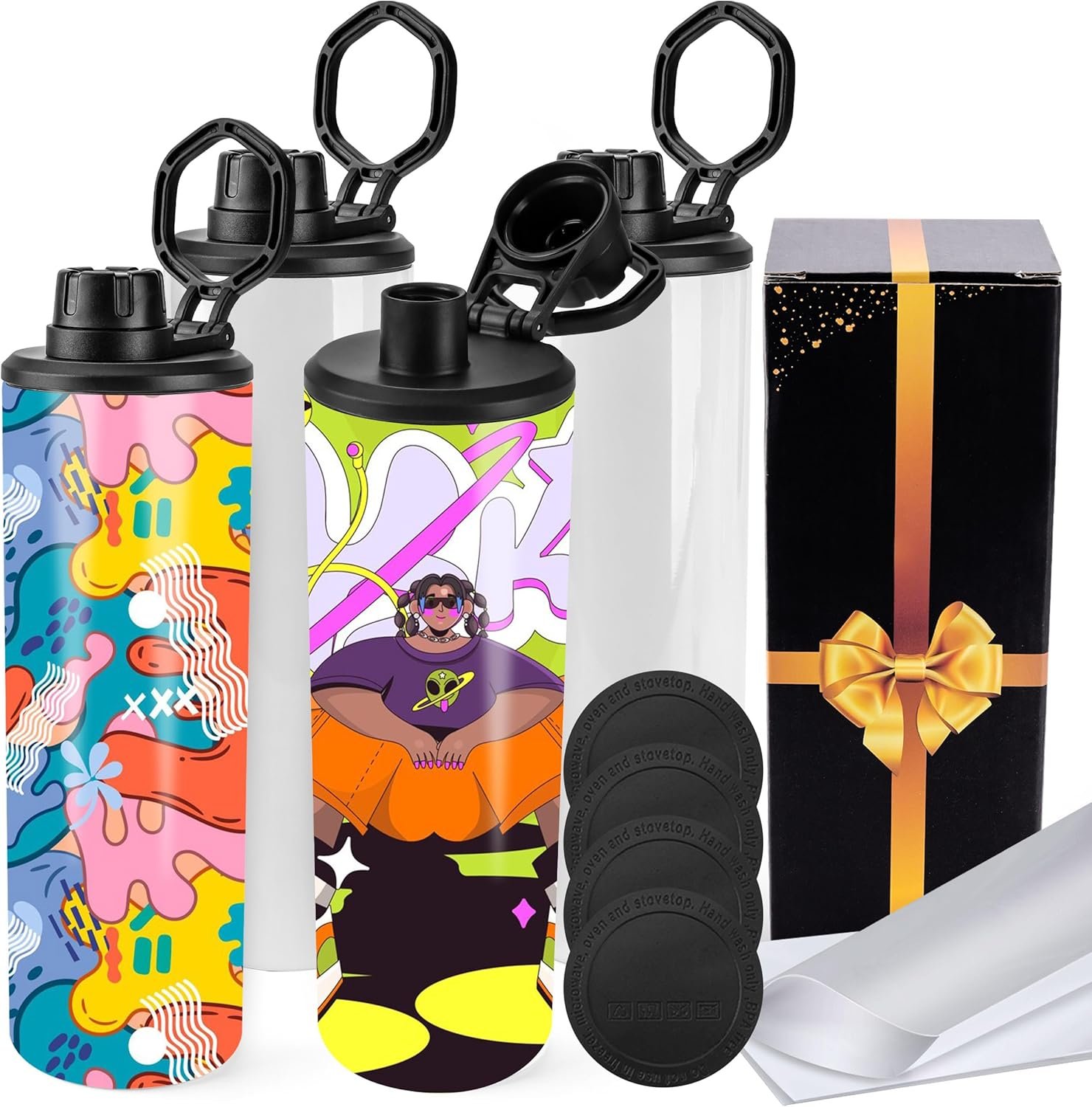
Sublimation tumblers, explained: what the Joyclub 4-pack actually gets you right
Most blank tumblers for sublimation fail in one of two ways. The coating fogs. Or the cup itself isn’t straight, so your design wraps crooked and the seams don’t line up. The Joyclub 4-Pack, 20 oz Sublimation Water Bottle Blanks address both problems directly, and that’s really the whole pitch.
Start with the shape. Joyclub uses integrated molding to keep the barrel absolutely straight — no taper, no bulge, no subtle curve that throws off your wrap. If you’ve ever printed a full-wrap design on a slightly warped blank and watched the pattern drift out of alignment by the time it circles back to the seam, you know why this matters. A straight tumbler isn’t a nice-to-have. It’s the difference between a design that lines up and one that doesn’t.
Then there’s the coating. Joyclub markets this as a “special coating,” which is vague marketing language, but the functional claim underneath it is specific: no fogging, bright color transfer, consistent results whether you’re using a heat press or an oven. Fogging is the single most common failure point in sublimation blanks — cheap coatings absorb ink unevenly, and the print comes out hazy instead of saturated. A tumbler that resists that isn’t flashy. It’s just doing its job.
The lid solves a separate problem: leaking. Joyclub built these with a spiral-threaded, handle-style lid — closer to a sports water bottle than a traditional tumbler cap. That means you can toss it in a bag, a car cup holder, a gym duffel, without babysitting it. For a blank meant to double as a finished, everyday-use product (not just a display piece), that’s the detail that actually gets used.
Here’s how the process works, step by step. Pick your image, print it onto sublimation paper, and tape it to the cup using heat-resistant tape — this keeps the design from shifting mid-transfer. Wrap the printed paper in a shrink film sleeve, then use a heat gun to shrink that film tight against the cup. Tight wrap, no air gaps: that’s what keeps ink from bleeding or smearing. From there, you’ve got two paths. Oven method: roughly 338°F (170°C) for about 5 minutes. Heat press method: about 80 seconds. Both work. The oven is more forgiving for beginners since the heat is more even across the whole cup; the press is faster once you’ve got your settings dialed in.
A few things worth flagging before you buy. This is a 4-pack, which puts it in a strange middle zone — too small for a serious reseller doing bulk orders, a bit much if you just want to try sublimation once. If you’re testing the craft for the first time, that’s still a reasonable entry point. If you’re building inventory for an Etsy shop, look at Joyclub’s larger bundles instead; they sell the same blank in 10-pack and 16-pack configurations, sometimes bundled with the 20 oz water-bottle-with-handle variant.
Worth noting, too: several nearly identical products exist across Amazon under the Joyclub name — a straight skinny version, a flat-bottom “Pro” version, a glow-in-the-dark version, a dual-opening sports version with a handle. They share the same core coating and molding tech, but the shape and lid style differ enough that it’s worth checking the exact listing title against what you actually need. “Straight skinny” and “flat bottom” aren’t interchangeable if your design template assumes one or the other.
On reviews: buyers consistently mention two things — the leakproof lid holding up in daily use, and the sublimation process itself going smoothly without fogging or fading. That tracks with the product’s own claims, for what that’s worth. Reviews from a brand’s own listing always skew favorable, so treat that as a data point, not a verdict.
Is this the best sublimation blank on the market? Hard to say — there are a dozen near-identical competitors (WRINGKIT, Micellwuu, OFFNOVA, Draheri) all making the same “leakproof, coated, insulated” pitch at similar price points. What Joyclub has going for it is volume of buyers and a track record across multiple product lines, which counts for something when you’re trying to avoid a batch with inconsistent coating quality. If you’re new to sublimation and want a low-risk way to test the craft on a durable, well-reviewed blank, this is a sound pick. If you’re sourcing at scale, go straight to the bigger packs — the per-unit math works out better, and you’re buying the same cup either way.